Friday, December 15, 2017

'Tis the Season


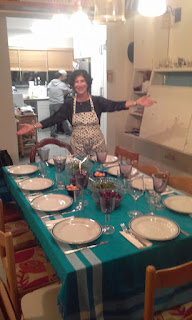
The Jewish year is filled with holidays and celebrations. In fact, there is only 1 month of the Jewish calendar that doesn't have any. Hanukkah is a minor holiday. In order to know what that means you have to understand what the major ones are. Basically they are the ones ordained in the Torah - Rosh Hashanah, Yom Kippur and the three pilgrimage festivals (Passover, Shavuot and Sukkot). The  post-Biblical holidays such as Purim and Hanukkah are considered minor, but still very important.

The holiday celebrates a miracle that occurred after a victorious rebellion in the year 200 BCE (give or take a few years) against the ruling Seleucid king, Antiochus IV, who essentially outlawed Judaism and profaned the Temple in Jerusalem. (Current scholarship claims it also had elements of a civil war, but I'll leave that to the scholars.) The miracle was that a one-day supply of untainted oil lasted eight days, which was how long it took to harvest, press and transport olive oil to Jerusalem. The oil was used to light the Temple's menorah, and had to be kosher. 

The only religious rituals are to light a special candelabra called a hanukkiah, and ideally place it in a window for all to see. No, it's not a menorah. A menorah has 7 candles, a hanukkiah has 9.

Hanukkah didn't become a big deal until the 20th Century, and for all the wrong reasons. Yes, I am a grinch. In certain parts of Europe it was customary to give kids a few coins, but that was about it. Because of timing, cultural influences, and let's face it, a dilution of Jewish traditions and practices, Hanukkah found itself competing with what I consider the unfortunate aspect Christmas - gimme gimme gimme. Today gift giving and decorating are what define both holidays for a lot of people. We aren't better off for the loss of spirituality.

Like any Jewish holiday, Hanukkah has it's culinary traditions, in this case oil. In Eastern Europe the  food that is linked to Hanukkah is latkes (potato pancakes). In the Middle East and North Africa it's sfinge (a churro type of donut). In Israel it's sufganiyot (jelly donuts). 

Latkes. I made two varieties this year - carrot/zucchini and traditional potato.

Sfinge. Yafit's specialty.

Original jelly donuts. Simple, uncomplicated, strawberry or raspberry, take your pick.

Over the years sufganiyot have evolved from basic raspberry or strawberry filled donuts to the astounding variety available today. Every year something new gets added. The latest twist is savory sufganiyot, filled with meat and tehina. Turn up your nose if you want, but they've really caught on. (Ever hear of chicken and waffles?) 


How do you pick just one?

When I look at sufganiyot I see way beyond temptation and calories. They are a metaphor for Israel. There are many reasons why Israel is the amazing success story that it is. Creative thinking, problem solving, dreaming big, asking why not and not fearing to fail. All of these characteristics are embodied in these wonderful pastries, which have gone from simple to astounding in just 70 years.

Wishing you a very happy Hanukkah and Shabbat Shalom from Jerusalem,

Peggy and Sid


Friday, December 8, 2017

Witnessing History


Ever since Trump was elected one of the threads of conversation among supporters of Israel is will he or won't he move the US Embassy to Jerusalem. Many voiced the opinion that it was just the price of admission to get the "Jewish" vote. Others viewed it through the prism of candidate Trump - he had no need to bribe any particular constituency. Looking back on the campaign, it was more thematic than specific. He talked about the principles and values of flyover America that got him elected. The shock and reaction still reverberate. The Democrats would rather die than cooperate. The Republicans would rather go down in flames than cooperate. Appointments and legislation are stuck in limbo. Leaks coming from government departments border on treason. Every thing is politicized. Anarchy seems to be just around the corner.

Every president since Gerald Ford has promised to move the US Embassy to Jerusalem, where it belongs. It is scandalous that the capitol of a sovereign nation isn't recognized, especially by its nominal strongest ally. I don't know of any other country that is subjected to this kind of humiliation. Moving the embassy has been a law in the United States since 1995, and was reaffirmed six months ago by Congress almost unanimously (a miracle considering how fractured Congress is). So how is it that every president since 1995 (Clinton, Bush, Obama and Trump) has been able to get away with not enforcing this law? By a little loophole called a waiver, that has to be signed every 6 months. Since 1995 the one thing every president has in common is their adherence to signing that waiver. In May, when Trump signed, the reaction was deja view all over again. This was compounded when he decided the pick up the gauntlet of solving the Israel-Palestine crisis. A lot of people were disappointed and figured that Trump, like all his predecessors, was just saying whatever he had to say to get elected.

There was a lot of speculation during the past week about a forthcoming announcement concerning the embassy relocation. Will he/won't he? Is it just more hype? Will he again cave to the received wisdom that any change in the status quo will cause the entire middle east to go up in flames?

On Wednesday Sid and I watched the speech that will go down in history. As I listened to the precise and carefully crafted speech, I thought back to November 29, 1947 and May 14, 1948. People were glued to their radios listening to the UN Partition Plan vote and the declaration of the establishment of the State of Israel. I thought about the blood and struggle that accompanied Israel's creation, and the wars that have been fought ever since. I thought about ramifications and repercussions, about doing and failing to do, about risks for peace and land for peace. As he's done since the day he announced his candidacy, Trump made it clear that he was breaking the mold (Let Trump Be Trump). In so many words he quoted Einstein's definition of insanity and said enough is enough, no more.

No, the sky won't fall. Security has been ramped up for the promised 3 days of rage that will come and go. But this is nothing new. There is terrorism every day here, but it's not reported outside of Israel. Last week alone an Israeli soldier was stabbed to death in Arad. A 70-year old was the target of a car ramming. He was only slightly wounded, but a bystander was severely injured. A group of kids on a hike was attacked by an Arab lynch mob. The 70-year old and the parents accompanying the hikers were armed and shot their assailants. More Arabs will be killed and wounded because of their self-inflicted violence than Israelis. This has been the case ever since the first of the Arab refusals. The fact has to be mentioned, over and over and over, that if the Arabs had accepted the UN Partition Plan, which gave THEM a state of their own, today they would be making plans to celebrate 70 years of statehood. They would have had everything they claim to want - independence, sovereignty, self-determination. And all that hysteria and hyperbole about blowing up the peace process and the two-state solution? There is no peace and there is no process. If there was any intention by the Arabs of working things out, their leadership would have called for quiet rather than violence. The goal was, is, and always will be to wipe Israel off the face of the earth. They don't want a state, peace or prosperity. It's beyond me that people still don't get that.

And by the way, where was the outrage back in April when Russia recognized Jerusalem as Israel's capitol? Where were the demonstrations against the Czech Republic, which did the same? What about burning the flags of other countries, from Belgium to the Phillipines, that are looking at real estate in Jerusalem? Betcha didn't know that, right? Because it wasn't reported, because there was no rioting in the streets of Ramallah and Gaza, and because the press only reports what makes Israel and the US look bad.

No one should make assumptions about where this will lead. Personally I think the best possible scenario is the absence of violence and terror because there will never be peace until the Arabs decide that's what they really want. Golda Meir said there will be peace when the Arabs love their children more than they hate ours. That was 45 years ago, and they are more willing than ever before to use their children as suicide bombers and human shields. A desire for peace has to come from the bottom up, because it certainly won't come from their leadership. In high school, when we studied about the 100 Years War, I couldn't understand how something could go on for that long. Now I do.

In spite of the hysteria, life continues as normal. We had a lovely couple of days at the Dead Sea, one of our favorite places in the world, and we celebrated another bar mitzvah - Moshe and Liat's son Yaniv. Last night we had dinner with Dori and her boyfriend Itzik in Tel Aviv. The big excitement was getting home. Our bus broke down about 15 minutes outside of Jerusalem. While boarding another bus that stopped to pick us up, someone told us if there were no seats left on this bus another would be coming in 5-10 minutes. We were more concerned with getting back to Jerusalem and didn't mind standing. But several people insisted on giving up their seats for us; there are advantages to being, ahem, older. When we got to the Central Bus Station in Jerusalem, the local bus to take us home was waiting and we hopped on. We didn't even get to the next stop and the bus hit a roadblock.  A police car had cordoned off the street and there was no place to turn around so we were stuck for about 20 minutes. We thought it might be more demonstrations by the ultra-orthodox fringe against having to register for the draft. But when they finally let traffic resume I saw the reason for the hold-up - the van from the bomb squad. False alarm, and a fact of everyday life here.

View from our hotel room with the Dead Sea and Moab Mountains of Jordan

Sid, relaxed after a massage


Shabbat shalom from Israel's capitol,

Peggy and Sid


Friday, December 1, 2017

Melabev


In 2013 Sid and I decided to see what it would be like to spend a few months in Israel. We selected the months of November, December and January. We got to experience Thanksgivukkah, the very first time Thanksgiving and Hanukkah coincided (an event that won't be repeated for another 10,000 years), in a place that would give the event special meaning. It was the year of the toaster oven turkey, the postage stamp size apartment, and the meter and a half snowstorm that paralyzed Jerusalem for 5 days. Our granddaughter Dori had made aliya and was getting ready to enlist in the IDF, our granddaughter Meital spent a semester at Muss high school in Beer Sheva, and we celebrated our grandson Nir's bar mitzvah. 

It was also the 10th Melabev Hike for Alzheimer's.

One day I was reading the Jerusalem Post and saw an ad for a hike being sponsored by an organization I had never heard of, in memory of someone Sid knew who had early onset Alzheimer's. I said we have to get involved with this. A couple of phone calls later we were signed up for a hike in the Judean Desert, along with about 50 other people. We have supported Melabev ever since.

Melabev was founded in 1981 for the comprehensive care of dementia patients. Services include day care centers, support groups for family members and caregivers, wellness calls, placing qualified home care workers, at-home therapeutic activities, a memory clinic, a proprietary software program of mind-stimulating exercises, a Neuronix Clinic and ground-breaking research unit.

I have toured their facility in Jerusalem and spoken with many on the professional staff. Everything about this organization impresses me, but some things stand out. They have a unit, composed strictly of volunteers, who make daily wellness calls to older adults living alone. In addition to saying hello, they provide practical help such as errands and home repair services, and referrals to other non-profits who provide medical equipment and meals. The at-home services include therapeutic activities such as art, gardening, fitness and cognitive stimulation for home-bound patients as well as in nursing homes. Support groups not only support families and caregivers, but also serve as networking centers for people who have to navigate the maze of bureaucracy in order to receive the benefits and services they are entitled to.

Melabev also has a research unit which developed Savion, a computer program designed to maintain and improve memory. The most exciting and optimistic breakthrough is Neuronix, which combines cognitive training and electromagnetic brain stimulation. The system has been proven to work in studies at Harvard and the treatment has been approved by the Israeli Ministry of Health as well as European Commission. Knowing how Europe feels about anything coming out of Israel, their approval really means something.

So yes, this episode is a request for funds.

Sid and I just completed a two-day hike in the Galilee for the 2017 Hike for Alzheimer's. We selected the "moderate" route; from time to time it was moderate, but at other times it was very challenging. When you do something like this there is a big sense of accomplishment, but in the end it's really all about raising funds for this remarkable organization. We urge you to donate in support:

http://hike4alz.melabev.org/hikers/

Just click on one of our names (or both if you insist) and sponsor us in any amount. Feel free to tell your friends. You will be doing a huge mitzvah and contributing to the quality of life for alzheimer's patients and their families. And maybe one day coming up with a treatment for this heart breaking disease. You will have our eternal gratitude.

Shabbat shalom from Jerusalem,
Peggy and Sid

The "moderate route" group. We started at Rosh Hanikra.

These nasty bushes were the challenge.
Thorns and thistles, and they hurt when you got stuck.

This is what serves as a trail marker in Israel.

Uh-oh. Are we lost?

This is Chen. At 4'10", she was the security guard and paramedic.
She was a paramedic in the Border Patrol.
We made it to the end!

Our post-hike stop was the Bahai Gardens in Akko. 


Friday, November 24, 2017

Giving Thanks


Even Americans who have lived in Israel for a short time don't necessarily celebrate Thanksgiving. For some it's not even on their radar screen. One of the people I invited to join us responded "remind me, when is it?". For others, thoughts turn to Thanksgiving the moment October turns into November. It's hard to give up a cultural icon. The degree to which Thanksgiving is on someone's mind is indicative of one of the differences between Americans who move here to become Israeli and Americans who move here to be Americans living in Israel.

On the other hand, many Americans I know who have been here for decades have fond thoughts about the holiday. They might not necessarily go to the trouble and expense of making a traditional dinner, but if they want turkey and all the time-honored trimmings several hotels offer Thanksgiving menus.

When we planned this trip one of the things we looked forward to was celebrating this quintessentially American holiday here, for the second time since we started coming for long stays. This time we have a full oven and 5 burner cook top, a big improvement over the 2 burner + toaster oven micro-kitchen we had the first time.

We had an eclectic group of 10 - friends and family - lots of food, wine and conversation. The topics included the inevitable: compare and contrast Thanksgiving and Sukkot, when will the next war break out (imminently, according one guest), and Israeli politics.

One of the guests brought a custom that she, and many of us, grew up with. We went around the table and everyone said what they were thankful for. As I listened I heard a lot more than what they said. Everyone has a back story, some quite painful. Yet here we were, talking about the things in our lives that we are grateful for. My takeaway, and this isn't the first time, is no matter what, we don't have to be ruled by whatever bad things that might have happened or that are still happening. Choose happiness. Choose gratitude. Choose life. 


Green beans, beet/fennel salad, braised cabbage, stuffed persimmons (hey - it's the middle east where a meal isn't complete without something stuffed) chestnut dressing, sweet potatoes with squash

Sid and Moshe in the background tending bar

It's all about color

Arnold and Batia Clevs, Aliza, Sarah Palmer

Moshe, Shefa, Itzik, Dori 

Turkey supplied by Sasson, my butcher

Hoping your Thanksgiving was as filling and fulfilling as ours was,

Shabbat shalom from Jerusalem,
Peggy and Sid

Friday, November 17, 2017

Multi-Culturalism


Multiculturalism is alive and well in Israel, and we are the beneficiaries. 

We arrived in time for the 18th International Oud Festival. For anyone unfamiliar, the oud looks like a pregnant guitar with a broken neck. It's an integral part of music from the Mediterranean basin. So is the kanon, which is a trapezoidal stringed instrument that sounds curiously like a harpsichord. We went to 3 performances representing the musical traditions of Greece, Turkey, Egypt, North Africa, and of course Israel. 

My intention was to upload the videos I made at each of the concerts, but I've been defeated by technology. So for this week all that remains to say is ...

Shabbat shalom from Jerusalem,
Peggy and Sid


Friday, November 10, 2017

My Kingdom for a Can Opener


This country is booming. 

Israel broke into the top 10 on the Bloomberg Innovation Index for 2017. According to Deutsche Bank, the Shekel is the world's second strongest currency (after the Chinese Yuan).  During the past 12 months the value of the Shekel increased 6.1% over the Dollar, Pound and Euro. This isn't necessarily good because it makes exports more expensive, and contributes to a trade imbalance. And of personal interest, the cost of apartments went up by the same margin. But it speaks to the strength of the economy.

Boy George (remember him?) performed in Tel Aviv last night. From the stage, loud and clear in plain English, he told Roger Waters (who nobody remembers) to f--- off. The list of international artists and performers who will appear in Israel in the next few months is pages long.

The number of states that have enacted anti-BDS legislation increases almost daily, along with the number of BDS resolutions that have been defeated. In fact the BDS movement would be on the ash heap of movements if it wasn't for US college campuses, and the collaboration of "progressive" Jewish groups such as JVP and mainstream organizations such as Hillel, all of whom should be utterly ashamed of themselves. Although this is a topic for another time, it pisses me off and I won't stop railing against BDS and their supporters, no matter who they are. 

And what about breakthroughs in science, medicine and agriculture? Crop yields, water conservation, medical technology, treatments and cures for diseases, you name it and Israel has made the world a better, safer and healthier place. 

Even the self-service check out at the supermarket works.

So WHY can't I open a can?

Two venerable kitchen gadgets that no one can live without are a vegetable peeler and can opener. In all the years I've been coming here I have yet to encounter a kitchen that is equipped with a working model of either one. The vegetable peelers are dull and useless, and the can openers are either non-existent or the ones people used to take on camping trips, also useless. 

To date I haven't seen an innovation for the vegetable peelers, but the issue of the can openers is another matter. Israeli ingenuity being what it is, and clearly in recognition of the fact that no one has a decent can opener, several years ago manufacturers started putting a pop top on cans. Problem solved, right? Maybe in theory, because more often than not the pop top pops off in the middle of opening the can. In most cases it doesn't matter so much, because the can is half opened and the contents accessible. Yes, it's a little messy sometimes, especially when it comes to tuna and sardines, but nevertheless at least you can get the contents out. 

But what happens when you have a big (15 oz) can to open? The pop top pops off as soon as you grab it. And that's just what happened this morning as I was preparing something for dinner. We scoured the kitchen and did find one of those old, useless camping can openers. Of course it didn't work. There was nothing even remotely close to a church key. The only tools we had were a couple of pliers, which we used as hammers, a corkscrew serving as the nail. All I needed was a small opening in order to pour the contents (crushed tomatoes) out. Nothing was going to work, so Sid to the rescue. 

Luckily this happened before he went on his morning run to the grocery store. Going shopping on a Friday is a combat sport and you surely don't want to have to do it twice. He had to go to three different stores until he finally found a decent can opener and I was able to finish my cooking.


Iraqi Buri in tomato sauce

As I've said countless times, embrace the chaos and remember: there's never a dull moment.

Shabbat shalom from Jerusalem,

Peggy and Sid


Sunday, November 5, 2017

100 Years


A lot has been made this week of two significant hundredth anniversaries: the Battle of Beersheva and the Balfour Declaration.

They are intertwined.

The Battle of Beersheva was the last great cavalry battle ever. It took place on Oct 31, 1917, between the Egyptian Expeditionary Forces (ANZAC Mounted Division and Light Horse Brigades) and Germany's Turkish allies in World War 1. The battle created a strategic opening in the Turkish line which led to the liberation of the Negev and Jerusalem. It was the beginning of the end of the Ottoman Empire which ruled this region for 500 years.

The anniversary of the battle was celebrated with great fanfare. 100 Australian horsemen, from the same units that fought the battle (including some descendants of those soldiers) took part in a reenactment of the defining charge through the desert.

The PM of Australia and the Governor General of New Zealand were here for the occasion. This in itself was a big deal because New Zealand was one of the sponsors of the vicious anti-Israel UN Security Council resolution 2334 of December, 2016, declaring the so-called "settlements" illegal according to international law. The resolution was one of Obama's parting gifts to Israel, and New Zealand's sponsorship created a serious diplomatic rift. Subsequent elections in both the US and New Zealand resulted in governments that have taken vastly different directions in their relations with the rest of the world, especially with Israel. The presence of New Zealand's GG reflected that new direction and the symbolism was obvious to everyone here. 


The Ottomon Empire was crumbling and to the victors go the spoils (unless the victor happens to be Israel and the war happened to be in 1967). The French and British allied powers were going to fill the vacuum and the spheres of influence were codified as early as May, 1916 by the secret Sykes Picot Agreement. 


The Balfour Declaration was issued on Nov 2, 1917 against this background.

But what was the connection?

Last Sunday we went to see an operetta called Intrepid. The quality of the production was high school at best, and the subject matter really doesn't lend itself to a musical. That aside, it was the story of a chapter of Israel's pre-state history that doesn't get nearly enough credit or attention: the story of the NILI spy ring, which was active from 1915-1917.  The NILI group was pro-British and supplied vital information about Turkish logistics, troop movements and geography (particularly the location of water wells) that was vital to the British war effort. While heavy lobbying for a Jewish homeland by the World Zionist Organization, Chaim Weizmann and others had been ongoing, it's fair to claim that the Balfour Declaration was payback for the contribution of the NILI spys to the allied victory in World War 1.  

Another anniversary was marked this week - the 22nd since the assassination of Yitzhak Rabin. 

The thread that links all these events is the blood that has been spilled for the sake of building a strong, safe and viable Jewish home in this tiny corner of the world.

May the memories of all those who give their lives for the establishment and preservation of the State of Israel be a blessing for those of us who have the privilege of benefiting from their sacrifice. 

Shavua tov from Jerusalem,
Peggy and Sid